
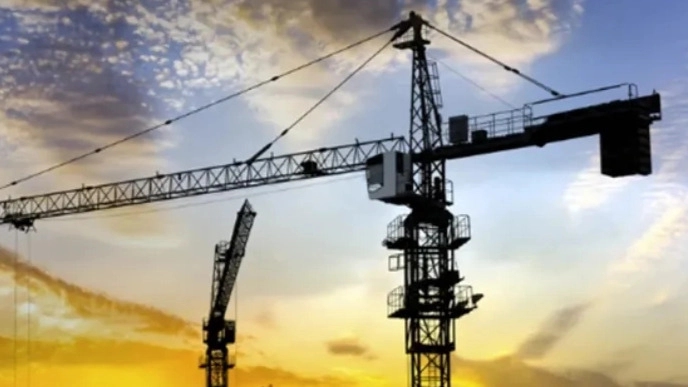
This device uses a driving arm to lift and move the hanging rope or cable. For this reason, machines that only provide vertical or horizontal movement for the user and do not use cables cannot be classified as tower cranes.
Types of Tower Crane
jib crane
In a construction crane, the jib is a long horizontal arm attached to a vertical tower. One end of the arm extends horizontally across the work area, while the other end carries counterweights. Also, a load wheel that holds the lift cable moves along the arm to help move the equipment. This type of tower crane usually needs a second crane for assembling and disassembling parts at the workplace.
Lofing pocket tower crane
Loafing construction crane or loafer is another common type of construction tower crane. This crane is recognizable because of its diagonal arm that extends from the top of the mast (tower) at an angle. Unlike a Sarcheshi tower crane, in jib luffing, the hook point is at the end of the arm.
Tower crane counterweights are placed closer to the tower when combined with a diagonal arm; As a result, the pocket luffing usually has a higher capacity compared to the overhead crane. Unlike the hammerhead crane, the diagonal arm can move inward and outward (from vertical to 30 degrees angle). This type of movement allows the luffing pocket tower crane to operate in small spaces, which is why this type of tower crane is often seen in dense urban construction environments.
Derrick crane
Derrick construction tower crane is similar to luffing arm type and its dimensions are designed to be installed on roofs or small spaces. This type of small tower crane is mainly used to assemble or disassemble parts of tower cranes. Derrick tower cranes are often without an operator's cabin and are controlled remotely by wire or wireless.
The benefits of building crane
Tower cranes make the most difficult execution operations for construction projects easy. They are able to move long and heavy steel beams. If you need more information about the price, you can inquire about the price of the day. Carrying construction materials, concreting the structure, transferring heavy equipment and many other things are among the capabilities of tower cranes.
Tower cranes make it possible to build tall buildings in very tight urban spaces. Also, high speed, lower cost and efficiency are the advantages of using tower crane. Another advantage of using this device is the reduction of labor costs, because using a tower crane reduces the need to hire more people.